I found an article on Gallup from 2002 that caught my eye. It goes into the issue of who has actually smoked marijuana and some statistics on the fact. Statistics show that a third of Americans (34%) said they had tried marijuana at some point. Men were more likely than women to have tried it, 43% to 27%. One might expect to find generational differences, but the proportion of 18- to -29-year-olds and the proportion of 30- to -49-year-olds who say they have tried it are about the same -- 46% and 45%, respectively. However, the figure plummets to 14% among those aged 50 and older.
Some see Marijuana use as a "city problem" that has not made it's way to suburban America. In fact, there's the numbers show little difference in drug experimentation by population center. 38% of urban dwellers have tried marijuana, as have 31% of suburbanites, and 34% of people who live in rural areas.
As Republicans are much less likely than Democrats to think marijuana use should be legal (21% versus 36%), it stands to reason that Republicans would be less likely to have tried marijuana. From the poll, about the SAME amount of Republicans have tried Marijuana as Democrats. (33% to 31%).
It's always fascinating to see different ideologies in numbers. I personally would expect Republicans, being conservative in nature and against drug use, to have much lower percentages when polled on drug use. These numbers show how drug use cannot be characterized by party, race, religion or sex. Marijuana use is prevalent all over America. These numbers are from 2002, so I would have to imagine they have been on the rise ever since.
Wednesday, October 27, 2010
Wednesday, October 20, 2010
Drugs Across the Border
In a Gallup opinion briefing from February, 2009, it was found that over 6,000 innocent people were killed in the on-going drug war that is tearing apart Mexico. With Mexico being our neighbor to the south, it leads one to question where these drugs are heading? Could they be going to the United States, a country where drug use is highly patrolled? In Mexico,violence has soared since President Calderon declared war on drug traffickers in late 2006 and deployed tens of thousands of troops to combat the cartels; much of the surge is viewed as backlash against the crackdown. Bloodshed across the U.S. border has prompted some experts in recent months to issue dire warnings about Mexico's future stability and the potential security risks to the United States. A 2008 poll showed how large group of gangs have grown and whether common citizens are becoming fearful for their own innocent lives. Nearly 60% of those polled said that they have gang members living in close proximity to them and over 40%
say that direct drug trafficking happens in their neighborhoods. These scenarios are playing out all over Mexico. United States President Obama applauded Calderon for his "extraordinary courage and leadership" in dealing with drug trafficking and the related violence in Mexico. According to Obama's press secretary Robert Gibbs, the president has expressed his support during the meeting for "the valuable work being done under the Merida Initiative," the $1.4 billion U.S. counter-drug and anti-crime assistance package for Mexico and Central America. The drug war in Mexico seems to be never ending and continues to escalate daily. Travelers are being fearful of visiting the country it has become such a large issue. Americans need to question why drugs, in particular marijuana, has become such a sought after drug in Mexico, and whether the purchase by citizens of the United States is what is inciting this drug war to the south. With marijuana continuing to stay illegal and patrolled in the US, one can only imagine this gruesome war to the south continuing to escalate.
Thursday, October 14, 2010
ABC News Quiz
Today I came across a quiz about marijuana that I found interesting from the National Institute on Drug Abuse (NIDA) and posted on the ABC News website. To even my surprise I received at 7 out of 7 on the quiz. I would suggest everyone to take this poll to gain some greater knowledge about the popular drug.
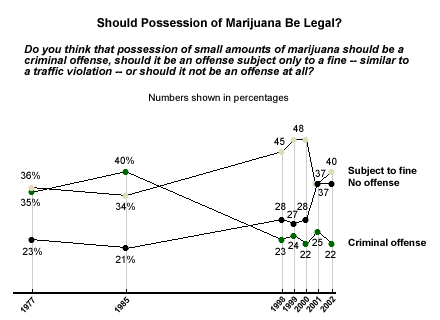
Also, I recently read a Gallup Poll that spoke about Canadians and their public opinions about marijuana. The Gallup article is titled, "Canadian Relax Views on Marijuana," and goes into detail about how in the 1970's Canadians were fairly evenly divided on the legality of possessing a small amount of marijuana. Thirty-five percent of Canadians believed that it should be a criminal offense, 36% believed it should be an offense subject only to a fine, and less than a quarter (23%) thought that possessing a small amount of marijuana should not be considered an offense at all. In only twenty five years opinion has shifted in support of treating marijuana possession less harshly. In the 2002 poll, 40% of Canadians said that the possession of a small amount of marijuana should be subject to a fine, while a similar percentage (37%) said it should not be considered an offense at all -- only 22% said it should be a criminal offense. The bottom line is that throughout North America, individual citizens are becoming less strict about the use and possession of marijuana. This poll goes to show that America is not the only place where common people are relaxing on their public opinion of marijuana.
Tuesday, October 5, 2010
Record Breakers or Steroid Takers?
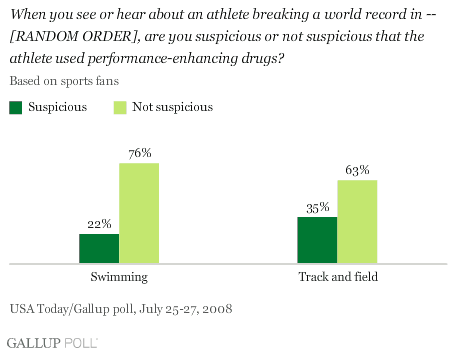
The 2008 Beijing Olympic Summer Games were a great time to be a sports fan. Athletes like Michael Phelps, Usain Bolt, US Men's Basketball and US Gymnastics all performed tremendously and came home with multiple gold medals to show. About two years about, right before the games began in August, Gallup polled 1,007 adults via telephone about their suspicions of Olympic athletes heading into the games. Most of those polled said they are not suspicious about the use of performance-enhancing drugs when they see or hear about an athlete breaking a world record. About 35% said that they feel suspicious when they see a track and field athlete break a world record, while only 22% feel suspicious when they see a swimmer break a record. Performing enhancing drugs are not a new concern in the Olympic games. They became extremely widespread in the 1980's, mostly with track and field athletes. By the 2000 Olympic games in Australia, many athletes were "doping." Marion Jones, an American Olympic legend from the 2000 games served prison time for lying to a federal grand jury about her use of performing enhancing drugs. She has since been stripped of her medals. Evidence shows the people are still confident that their athlete are not "cheating", especially in Olympic swimming. In all, performing enhancing drugs have continued to be at the forefront of the games and higher rates of testing should be able to provide proof the our athletes are no longer cheating the games.
Thursday, September 30, 2010
Prohibition of Marijuana
This past week while researching the website PollingReport.com I came across an article with great statistics concerning the use of illegal drugs and Americans opinions. What I took away was the amount of growing Americans who would be in favor of the legalization of marijuana if a tax was implemented on it. Still, a solid 55% oppose the overall legalization of the drugs. With the argument of legalizing marijuana brings the argument of punishment if one if found in possession of the drug. 32% of those polled feel that if marijuana was in fact legalized it would reduce the amount of current crime. This can be compared to when alcohol was made illegal during Prohibition (1920-1933) the amount of criminal activity skyrocketed. Street gangs and bootleggers became extremely wealth all because of the crazy idea by the government to ban alcohol. It makes one think whether someday the same may be said about marijuana. With constant drug wars being fought in Mexico and the murder rate growing, something must be done in regards to this serious issue. Could the legalization of this "drug" potentially reduce crime and make America and the rest of the world a safer place? Time will tell.

Thursday, September 23, 2010
The number continues to grow. . .
A recent survey done by Rasmussen Reports shows that almost half of Americans (43%) now say that are in favor of the legalization of Marijuana. Although a strong 42% still favor Marijuana remaining illegal, it is fascinating to see how quickly Americans are jumping on the "bandwagon" of legalizing the drug. From February, 2010, to July 2010, the number rose 3%. This may not sound substantial, but in context to the number of citizens in this country it shows a large shift. Most of the respondents argue that the legalziation of marijuana should be followed in part by a strong governmental tax. Forty percent (40%) of Adults admit to smoking marijuana at some time in their lives, but 55% say they have never tried it. 61% of those polled who have tried marijuana agree with the legalizing the drug. This newest survey goes to show how quickly the public's opinion is changing on the topic on marijuana. Everyday more and more Americans are realizing the amount the country could be making on the taxation of this drug. As the percentage of people in support of legalization continues to grow, it may just be a matter of time before legalization becomes a reality.
Thursday, August 26, 2010
Drugs in America
Illegal drugs have always been a major foundation in American history. This topic of public opinion is nothing new. According to Gallup, recently Americans have began to come together on debate of whether the United States is doing enough to cope with the use of illegal drugs. This is the closest the numbers have been (34%) since the early 1970's. Since the beginning of the new millenium, about one-in-three Americans have felt that drugs have become an extremely serious problem. This percentage has stayed primarily the same throughout the past 10 years.
What I found most interesting about the Gallup Polls is the increasing number of people who think marijuana should be made legal. All the way back in 1969 only 12% of the American general public believed in the legalizion of marijuana. As recently as October of 2009 that number has already grown to 44% of Americans, and looks to be continuing to rise. Could this be because we live in a more "laid back" society? Could it be a that society is "revolting" against the government? These 44% of people could also be part of the 42% who would like to see a tax put on marijuana in order to make it safe and legal. What the Gallup Polls have showed me is that Americans views on drugs are constantly changing. If anything, it goes to show that no two people have the same feelings about illegal drugs in modern day American culture.
(Information from Gallup)
http://www.gallup.com/poll/1657/Illegal-Drugs.aspx
What I found most interesting about the Gallup Polls is the increasing number of people who think marijuana should be made legal. All the way back in 1969 only 12% of the American general public believed in the legalizion of marijuana. As recently as October of 2009 that number has already grown to 44% of Americans, and looks to be continuing to rise. Could this be because we live in a more "laid back" society? Could it be a that society is "revolting" against the government? These 44% of people could also be part of the 42% who would like to see a tax put on marijuana in order to make it safe and legal. What the Gallup Polls have showed me is that Americans views on drugs are constantly changing. If anything, it goes to show that no two people have the same feelings about illegal drugs in modern day American culture.
(Information from Gallup)
http://www.gallup.com/poll/1657/Illegal-Drugs.aspx
Subscribe to:
Posts (Atom)